
Let’s start mid-spiral, shall we?
You run an SEO checker on your website, it spits out a random number like an ex who wants “closure,” and suddenly you’re Googling, “is SEO hard to learn?” and contemplating switching careers to goat farming.
If this is you, welcome.
If this has ever been you, also welcome.
If you’re pretending this has never been you… I admire the confidence.
Today we’re talking about SEO score meaning—what it actually measures, what it absolutely does not mean, and how to understand SEO without feeling like you’re decoding the Da Vinci Code.
Let’s dive in. Cool professor voice on. Glasses pushed up. Microwaved warmed up coffee 3x in hand.
Table Of Contents
What An SEO Score Actually Measures
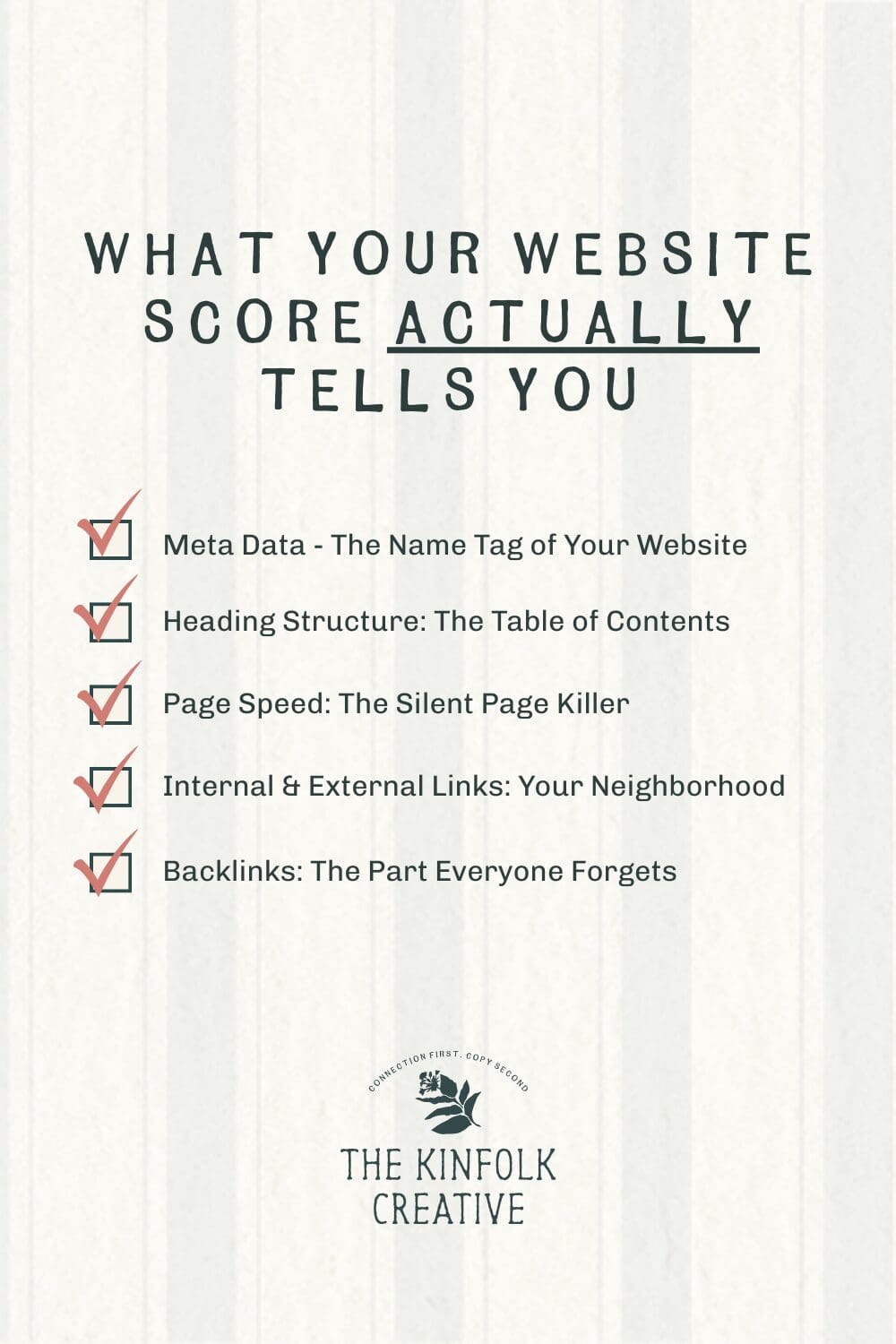
What an SEO Score Actually Measures (SEO Explained Simply)
Here’s the thing nobody tells you in SEO 101:
Your SEO score is not a grade.
It’s a diagnostic.
Think of it like going to the doctor. They’re not evaluating your personality, they’re checking whether your heart is beating and your blood pressure isn’t feral.
SEO is the same.
When a tool gives you a score—let’s say 85%—it’s measuring things like:
- Your meta data (Is it written? Does it fit the length? Is it duplicated?)
- Your heading structure (Do you have one? Does it make sense?)
- Your page speed (The report you shared clocked in at 0.47 seconds, slightly slower than recommended. Nothing tragic, no defibrillator required.)
- Your internal linking (Are links duplicated? Missing anchor text? Too long?)
- Your alt text (Does every image have it?)
- Your server configuration (GZip compression? Redirects?)
- Your external factors (Do you have any backlinks or are you operating like a digital lone wolf?)
None of this has anything to do with your creativity, your brand voice, or your ability to convert a reader into a paying client.
SEO score meaning = your site’s technical health, nothing more, nothing less.
Why SEO Scores Don’t Mean What You Think They Mean
Let me say something mildly controversial for the creatives in the back: SEO scores do not tell you whether or not Google likes you.
Google does not care about your score in an app. Google cares about:
- whether your content is useful
- whether humans stay on your page
- whether your site loads before they age 10 years
- whether other sites link to you
- whether your message is clear, consistent, and crawlable
SEO tools? They care about:
- whether your H1 exists
- whether your meta description is 986px instead of 1000px
- whether you misspelled “receive” as “recieve” (yes, your sample report called that out)
Useful?
Sure.
The big picture?
Absolutely not.This is why I always tell my clients:
SEO scores are feedback, not fate.
How to Understand SEO Without Losing Your Mind
If you want SEO explained simply, here it is. This is the whole thing boiled down to one sentence:
SEO exists to help humans and search engines understand your content.
That’s it. That’s the tweet.
The problem is, most SEO questions come from people who’ve been handed either:
- the tech-bro explanation (“optimize your GZIP server side compression header in HTTP status code—”)
or - the no-explanation explanation (“just blog consistently 🥰✨💖”)
So here’s your third option:
the cool professor version.
Let’s break down the core elements your SEO score is reporting on.
1. Meta Data: The Name Tag of Your Website
Tools love grading this because it’s easy to measure.
Your meta title and description tell search engines:
- what your page is about
- whether you understand basic formatting
- whether you’re prone to chaos
Meta-what? This blog is for you.
In your sample report, the meta description was the perfect length at 986px.
Round of applause.
If it had been too long, your score would’ve dropped even though—plot twist—it might’ve still performed fine on Google.
This is why understanding SEO requires thinking beyond the score.
2. Heading Structure: The Table of Contents
Search engines need hierarchy.
You need:
- 1 H1
- As many H2s as needed
- H3s for extra detail
- No heading Benson Boone backflips (“Why did you jump from H1 to H4??”)
In the sample report, the site scored 100% perfect on page structure.
Gold star. Extra credit.
3. Page Speed: The Silent SEO Killer
Listen.
Nobody likes a slow website.
Not you.
Your audience.
Google.
No not even your mom.
Your sample report flagged a 0.47s load time, which is just a hair slower than the recommended 0.4s.
This affects your SEO score meaning, but not your actual Google ranking in any catastrophic way.
If your load time was 6 seconds?
We’d be having a different conversation.
Head to this blog to learn 3 things that slow down your site & how to fix it!
4. Internal + External Links: Your Website’s Neighborhood Map
Internal links = how your pages connect
External links = proof you exist in the online world
Your report flagged:
- duplicate anchor text
- long anchor text
- missing anchor text
This brings your link score down even though your actual site might still rank beautifully depending on your content and backlinks.
Learning how to read an SEO report means knowing which of these issues matter and which ones are just “the grader being dramatic.”
5. Backlinks: The Part Everyone Forgets (But Google Doesn’t)
Your sample report showed:
- 1 referring domain
- 1 backlink
- 0 Wikipedia links (lol same)
This absolutely impacts your SEO score meaning because external factors form a big chunk of the calculation.
BUT.
This also has nothing to do with your website quality.
This is a visibility issue.
Not a scoring issue.
Also not a writing issue.
Definitely not a “you failed SEO” issue.
SEO FAQs (Your Actual Questions, Finally Answered)
Q: Is SEO hard to learn?
SEO is not hard.
SEO is overwhelming when you learn it from people who skip the human part.
Q: Do SEO scores actually matter?
They matter like tire pressure matters: helpful to check, not a personality test.
Q: Does blogging help SEO?
YES—but not because “Google likes blogs.”
It helps because blogging adds clarity, relevance, and internal linking. (This is why you’ll see recommendations like “SEO on blog” or “SEO blog write for us” floating around.)
Q: What’s a good SEO score?
70%–90% is normal.
100% is unnecessary perfectionism.
Q: How do I understand my SEO report without crying?
Look for the patterns.
Fix the technical stuff first.
Then improve content quality.
Then get backlinks.
What Your SEO Score Does Not Measure
This is the part where I lean back in my imaginary rolling desk chair, fold my arms, and tell you the truth:
No SEO score can measure:
- your voice
- your story
- your conversions
- your clarity
- your client experience
- your personality
- your creativity
- your authority
- your differentiation
- your cultural relevance
SEO can tell you if your website functions.
Only you can make it unforgettable.
So… What Do You Do With Your SEO Score?
Use it like a GPS:
- Fix the potholes (broken links, missing alt text, long anchor text).
- Tune up the engine (page speed, meta data, headings).
- Then drive the car like a normal person.
Your SEO score meaning is simple:
It’s a health check, not a judgment.
Google doesn’t rank scores.
Google ranks content, clarity, and connection.
And that?
You already know how to do it.
Want to save this blog for later? Hover over the photo below and press save!
Want help Improving your SEO score the right way?
If you want the cool professor to audit your website like it’s finals week, you know where to find me & I’ll leave the contact link right here for easy access.
If you enjoyed this blog, you’ll definitely want to check out this one all about finding the best keywords!
Wanna stay connected with us? Head to our instagram here!

SEO Score Meaning: What Your Website Score Actually Tells You (And What It Doesn’t)

We’re Kinfolk Creative—better known as the Visibility Duo.
One part strategy, one part storytelling, and a dash of “why didn’t I think of that?” We help business owners ditch the generic copy and finally show up online like they actually mean it.
If your website reads like a resume from 2014, your “About” page makes you cringe, or you’re just plain tired of yelling into the void—we’re your people.
We write words that sound like you, speak to them, and get clicks without the cringe.


