
You’ve heard it everywhere. Repurpose your content! And like, yea, that sounds great. But how do you actually repurpose blog content without simply copying and pasting the original post into five different places and calling it a strategy?
After yearssss of being in the online space — blogger first, social second — I can attest that repurposing content does not have to be as complicated as your brain is making it out to be.
But it does need to be more intentional than “let me throw this exact paragraph into an email and hope nobody notices.”
So, let’s talk about how to repurpose blog content in a way that gives your ideas more life, more reach, and more opportunity to connect without making your audience feel like they are reading the same thing over and over again in different fonts.
Why You Should Avoid Copy & Pasting Your Repurposed Blog Content
As an ADHDer, self-proclaimed “squirrel,” I am allllll about efficiency. BUT, I’m most certainly not about content slop, copy and paste content, regurgitated AI nonsense, or half-assed posts that exist only because someone said you “need to show up consistently.” No thank you.
The best content is rooted in intentionality, passion, and a desire to create. If you curated a beautiful blog post and then simply copied and pasted it over to your email, there is a good chance the same audience that consumes your blog is also on your email list.
And if they aren’t, what are you doing? 👀
This does not mean you can’t talk about the same idea in more than one place. You absolutely should. That is the whole point of building a content ecosystem.
But your audience should not feel like they are reading the exact same thing five different times across five different platforms…
Excavating the Core Message From the Topic
When I repurpose blog content, I’m not asking, “Where else can I paste this?”
Instead, I’m asking:
- What is the core idea?
- What is the strongest opinion?
- What is the most helpful takeaway?
- What story could make this more relatable?
- What platform would change how this needs to be delivered?
- What do I want someone to do next?
Every blog post should have a topic & core message.
The topic of this blog post is: repurposing blog content.
The message is: repurposing content is not about copying and pasting the same thing everywhere. It is about reshaping one strong idea so it can meet people in different ways, on different platforms, with different levels of context.
- The topic tells us what we’re talking about.
- The message tells us why it matters.
When Should You Repurpose Content?
Before you ever start to repurpose content, I believe thinking about the when/why is a great place to start because it’s going to influence how you repurpose your content.
When thinking about when to repurpose content, I always think about the following before moving forward:
- Do I have more to say about this information?
- Will different audiences relate to this content?
- Will the presentation matter how this content is received?
Each of these questions are going to influence whether or not I want to repurpose the content.
Now, each of these questions do not have to signal a green light for me to make a decision, I just need 1 to signal “YES”. AND, because I am the nuanced girly afterall, I will say that most of the time, I have a yes to all three, given that I am using my blogging first approach to curating content (that’s a convo for another day!).
Do I Have More to Say About This Information?
This is important to ask yourself when deciding if you should repurpose content because oftentimes there are layers that are within the foundation of the content that you’re curating. When you’re trying to repurpose blog content, start there. Before you make the Instagram post, before you record the reel, before you turn it into an email, pause and ask yourself: What is the one thing I want someone to walk away understanding? Because once you know that, you can create multiple pieces of content that orbit around the same idea without becoming repetitive.
For example, I already have thoughts about how I want to repurpose this very blog post. Here’s a snippet inside of my brain for a moment:
- Instagram carousel about why copy/paste repurposing makes your content feel flat.
- Wednesday Kin email about the difference between repeating yourself and reinforcing your message.
- TikTok about why “just repurpose it” is terrible advice without a strategy.
- Pinterest pin that leads people back to this blog post.
- Podcast episode about building a content ecosystem that doesn’t make you want to scream.
So, as you can see for this blog post in particular, I already have 5 avenues of content repurposing that I’d like to use [for now] regarding this post.
Depending on the different avenues that you have for your content, this list may be shorter or longer. Many folks inside of The Publishing House – our blogging membership have Podcasts, Substack, Youtube Channels, and more to repurpose content on. And, if I’m being really honest with myself, this could be a banger Podcast topic that I could use in the future.
Point is: you don’t have to have it all figured out right away. We’re just getting a feel for how far we can take this piece of content.
Will different audiences relate to this content?
I learned this methodology from a dear mentor of ours (Xanthe Appleyard) in her LOTP and Social Life programs. It’s something that I feel I always knew was a factor, but never really had the language for until I heard the message from her.
That being said, the idea is that humans digest information differently. The way someone digests a blog post is drastically different to an IG reel, or a Podcast. When you can repurpose content to multiple streams of platforms, you’re able to reach different audiences (which is the ultimate goal!).
- Someone reading your blog is likely in research mode.
- Someone reading your email is likely in relationship mode.
- Someone scrolling Instagram is likely in pattern-interrupt mode.
- Someone watching TikTok is likely in “please explain this to me like we’re sitting on the floor with a fun drink” mode.
- Someone finding you on Pinterest is likely searching for a specific idea, solution, or inspiration.
Turn One Blog Section Into A Standalone Piece Of Content
Because this blog post is so incredibly information-stacked, I can easily turn this post into a beautiful IG sequence, email series, or Podcast tour. An easy way to identify the “skeleton” of a diverse piece of content is to simply look at the heading structure of your blog post. Oftentimes, each heading section has enough information to perform as standalone content.
For this blog post, the sections could easily become:
- When should you repurpose content?
- How do you know if an idea has more to say?
- Why different audiences need different content formats.
- Why copy and pasting your blog into an email does not count as a strategy.
- How to repurpose one blog post across multiple platforms.
Each of those could become a carousel, reel, email, podcast segment, Threads post, or short-form video. And this is where blogging first becomes such a strong strategy.
Additionally, I do believe it is important to note that depending on your style of creativity, your brain may not begin the creative process through writing. It may begin through visuals like social posts, vlog-style format, etc. While others may begin with auditory processing through voice notes/podcasts. If that is you, head to this post to see our methodology of repurposing content when not beginning with a blog post.
Will the presentation matter how this content is received?
This question is a beautiful addition to the question above because it creates space for exploring whether or not your audience is more visual, auditory, or prefer to read content. When thinking about your ideal audience, you probably already have this figured out ie. the platform you use the most in business is most likely where your ideal clients thrive. However, there are always opportunities to invite more folks into your community and to do this is to repurpose content across multiple platforms.
For example, I am a visual/auditory processor. I need to visually see the content & hear a voice to connect to the message. However, there are nuances to this as I love a beautifully curated IG post that catches my attention right away.
The content that I am consuming on Substack, Pinterest, Tiktok, Insta, Threads, Blogs, Podcasts are vastly different from one another. Take a moment to reflect on where you consume the majority of your content and see if you can identify themes as to why.
Change The CTA Based On The Platform
A common repurposing mistake is using the same call-to-action everywhere. But again, different platforms have different jobs.
- If someone is reading a blog post, your CTA might be to join your email list, read a related post, inquire about your services, or explore your membership.
- If someone is reading your email, your CTA might reply, click through to the blog, join a workshop, or take one specific action.
- If someone is seeing your Instagram post, your CTA might be to comment a keyword, save the post, share it with a friend, or DM you.
- If someone is finding you through Pinterest, your CTA is usually to click through to the full post.
For example, this blog post could lead someone to The Publishing House because it naturally connects to blogging strategy, content ecosystems, and making your blog work harder for your business.
But if I repurpose this into Wednesday Kin, the CTA might be more conversational. I might ask readers to reply and tell me which piece of content they want to repurpose first.
If I turn it into an Instagram carousel, the CTA might comment “BLOG” and I’ll send them the post.
This matters because repurposing content is not just about getting more mileage out of your ideas, it’s about helping people take the next right step based on where they are encountering you.
A Simple Blog Repurposing Strategy You Can Use This Week
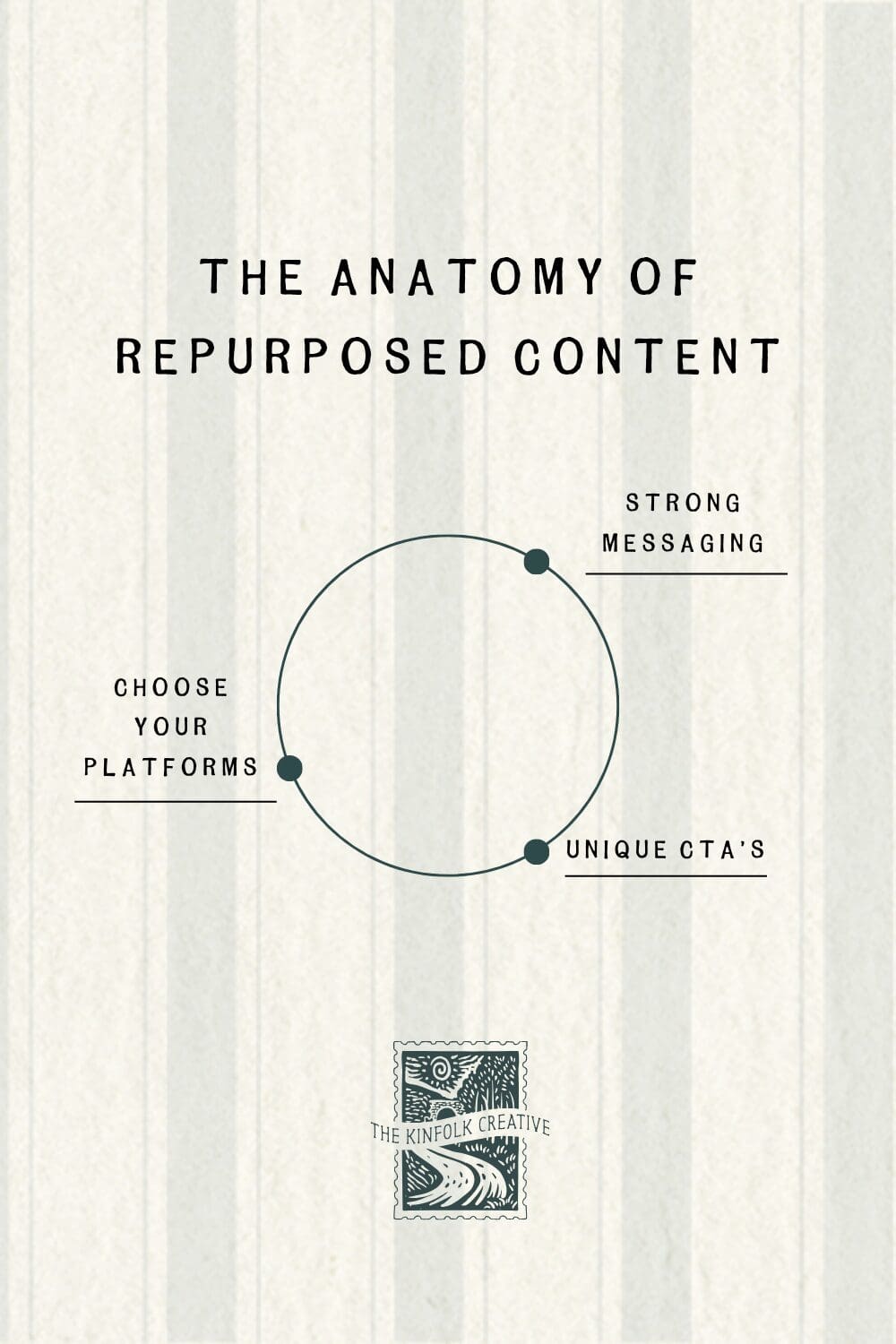
If you want to repurpose blog content without copy and pasting, here is the simplest way to start:
- Choose one blog post that has a clear message.
- Pull out the main sections or headings.
- Identify the strongest takeaway from each section.
- Choose one platform for each takeaway.
- Rewrite the idea for that platform instead of copying it over.
- Adjust the CTA based on what makes sense for that platform.
That’s it!
Repurposing Blog Content Helps Your Ideas Last Longer
One of the reasons I love repurposing content is because it honors the amount of energy it takes to create something good.
A strong blog post should not be published once, linked in your stories, and then sent to die quietly in your website archives. That is rude, honestly.
If you took the time to write something thoughtful, useful, nuanced, and aligned with your brand, it deserves more than one little moment.
It helps your audience encounter your message more than once, helps you reinforce what you believe without feeling like you are constantly creating from scratch, helps your blog become part of a bigger content ecosystem instead of a random collection of posts sitting on your website, and it helps you stay consistent without relying on the most fragile strategy of all time: waiting until you feel inspired.
Because let’s be so forreal—Inspiration is lovely, but she is not a reliable operations manager.
Your content needs a better plan than “I’ll figure it out when I sit down to post.”
Your Invitation To The Publishing House
If you want support building a blogging strategy that gives your content more structure, more longevity, and more ways to work across your marketing ecosystem, The Publishing House is where we do exactly that.
Inside, we help you turn your ideas into blog content that can support your SEO, your email list, your social content, and the bigger conversations your brand is here to lead.
Want to check out more blogs like this? Head here next!

How To Repurpose Blog Content Without Copy & Pasting

We’re Kinfolk Creative—better known as the Visibility Duo.
One part strategy, one part storytelling, and a dash of “why didn’t I think of that?” We help business owners ditch the generic copy and finally show up online like they actually mean it.
If your website reads like a resume from 2014, your “About” page makes you cringe, or you’re just plain tired of yelling into the void—we’re your people.
We write words that sound like you, speak to them, and get clicks without the cringe.


